SLOTracker — SLO + Error-Budget Burn-Down
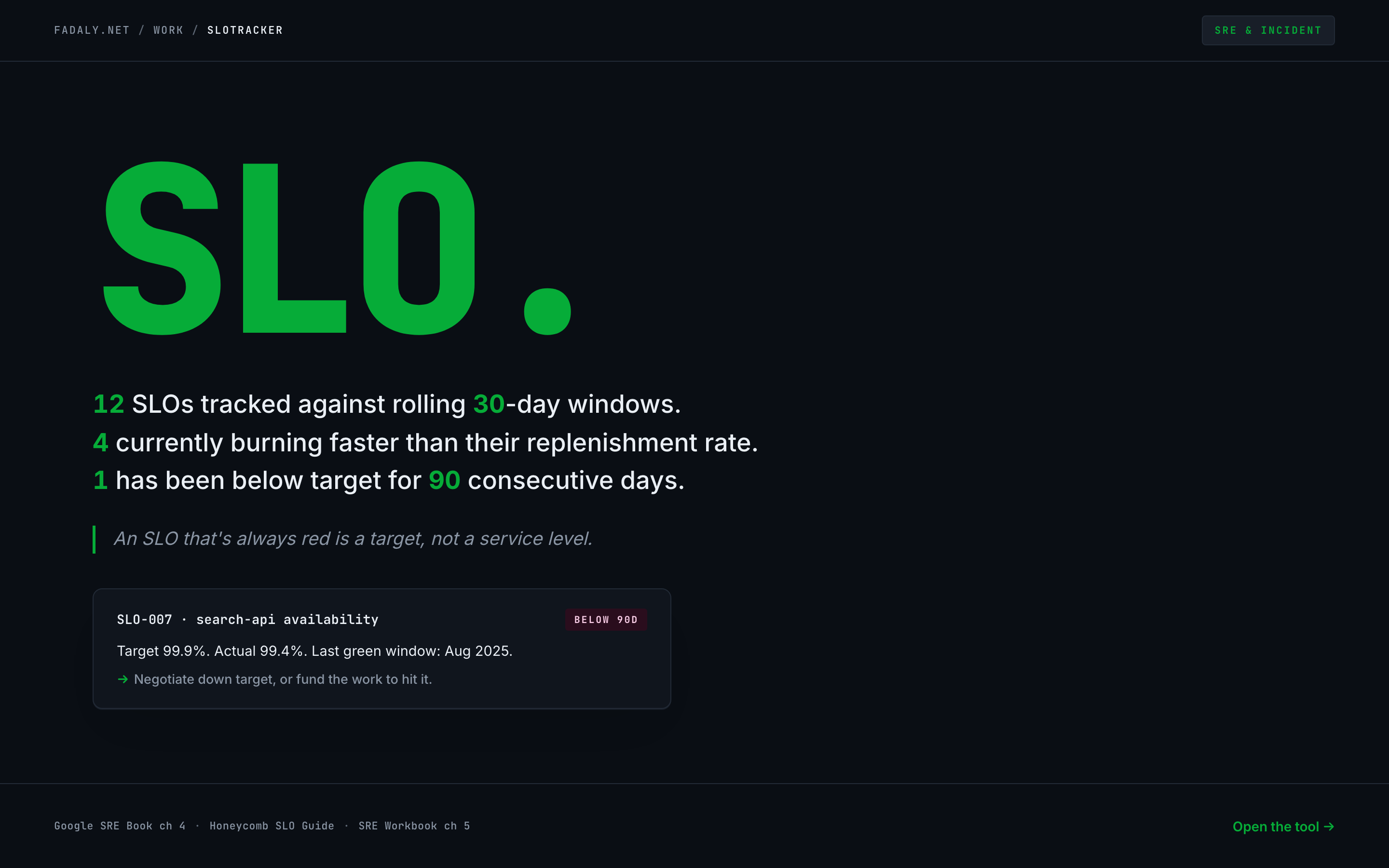
20 services × availability + latency + freshness SLOs. 30-day error-budget burn rate. Multi-window multi-burn-rate alerts (Google SRE Workbook ch. 5: 1h short window, 6h medium, 3d long). Surfaces 1 service that has fully exhausted its quarterly budget and 4 currently burning fast.
What it is
The shape behind every SRE platform’s SLO dashboard — Nobl9, Honeycomb SLOs, Datadog SLO, Google SRE internals. Per-service: availability + latency + freshness SLOs, 30-day error-budget burn, multi-window multi-burn-rate alerts.
What’s in it
- 20 services spanning tier-0 critical path (checkout-api, payments-worker, auth-svc, webhook-receiver, feature-flag-eval) through tier-1 (search-svc, cart-svc, product-catalog) and tier-2 (admin-tools, reporting-svc, data-warehouse).
- 3-axis SLOs per service where applicable:
- availability target (99.0%, 99.5%, 99.9%, 99.95%, 99.99%) + 30-day budget consumption
- latency p99 target vs actual
- freshness for data-pipeline services (analytics-pipeline, data-warehouse, billing-batch)
- Multi-window multi-burn-rate alerts (Google SRE Workbook ch. 5):
- 1h short window ≥ 14.4× burn → page on-call (consumes 100% in 30 days)
- 6h medium window ≥ 6× burn → page on-call
- 3d long window ≥ 1× burn → ticket (on-track to exhaust before period end)
- Worst-offender findings:
- SL09 inventory-svc — BUDGET EXHAUSTED at day 22; quarterly cap blown; engineering on-call to reduce feature velocity
- SL05 search-svc — burning fast (84% consumed at day 18) — CCR-lag pattern (cross-references IncidentLog INC-07307)
- SL19 kyc-pipeline — 72% consumed; on-track to exhaust 8 days early; vendor-side latency increase
- Cross-tool callbacks — every service references the related IncidentLog entry (INC-07307 search, INC-07014 cart, INC-03188 SES throttle) and the ChaosScore composite.
Why this shape
Google SRE Workbook ch. 4-5 introduced the modern SLO + error-budget pattern. ITIL 4 service-level management + SOC2 CC4.1 demand the same artifact: service-level objective tracking with documented variance and remediation. The killer feature: multi-window multi-burn-rate alerts — fires when burn is BOTH fast AND sustained, eliminating noisy single-window pages.
How it ships
Single HTML file, ~16KB. Zero dependencies. 20 services × 3-axis SLOs × multi-window burn-rate calculator in 200 lines of vanilla JavaScript.