The Wild Pest — AI Operating System for a Real Local Business
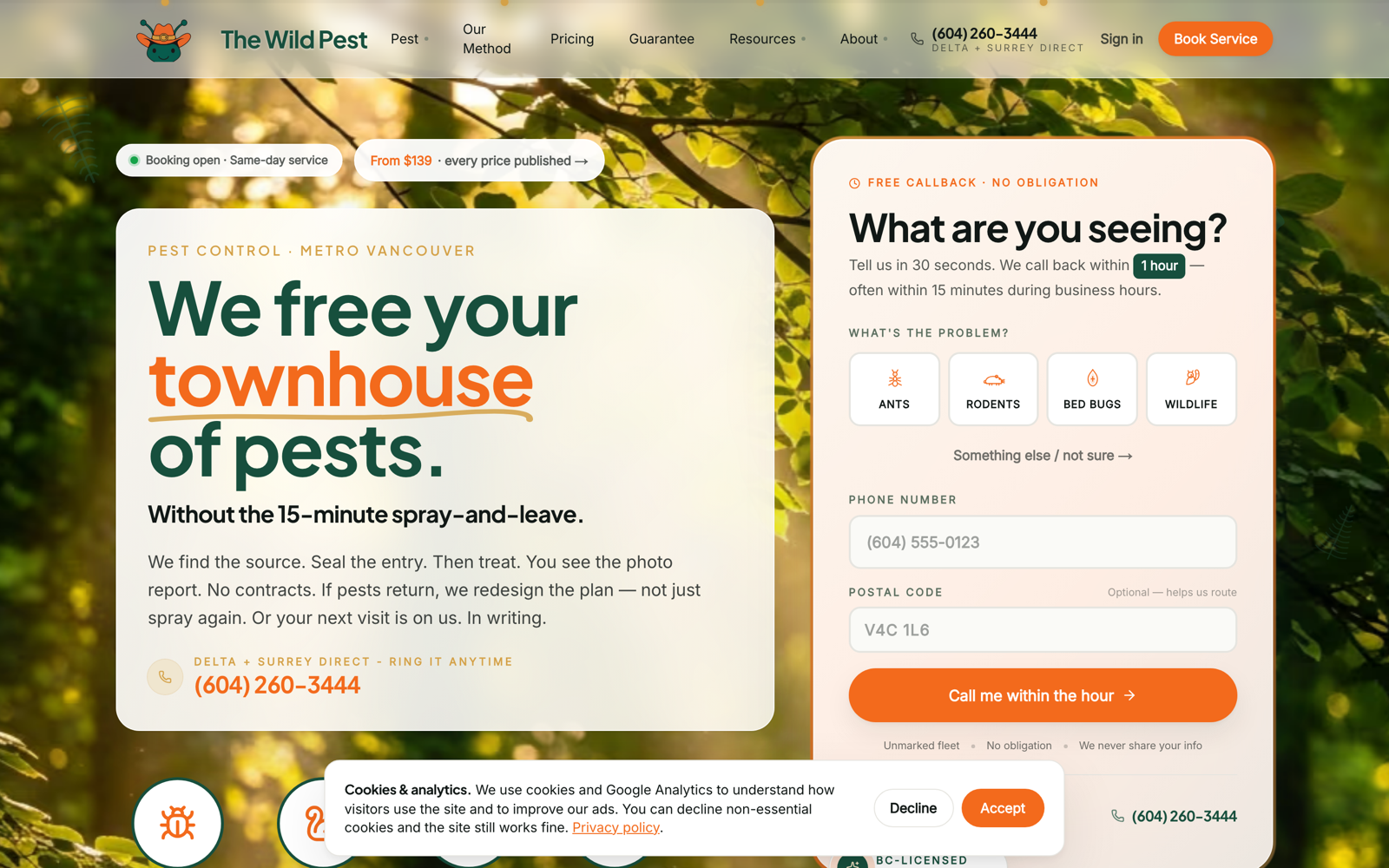
I'm running a Metro Vancouver pest and wildlife control company end-to-end on an AI-built operating system. Marketing site, admin console, technician PWA, customer portal — all built and operated by one person.
The Problem
Most “AI operator” stories are theoretical — someone runs a SaaS dashboard and calls it operating a business. I wanted to know what happens when the AI has to deal with the phone ringing, BC pest control licensing, real customers, and real money in the bank.
So I started a real pest and wildlife control company in Metro Vancouver. Real techs. Real trucks. Real callouts at 6 AM about raccoons in the attic. The whole thing runs on software I’m building.
The Architecture
Four portals, all part of the same operating system:
- thewildpest.com — public marketing site with local-SEO infrastructure (citations, schema, service-area pages) and lead capture wired straight into the admin console.
- admin.thewildpest.com — operator console for me and the dispatcher. Job creation, scheduling, technician assignment, invoicing, customer history. The thing I’m in every day.
- tech.thewildpest.com — Phase 3. A PWA for the field techs: today’s route, job notes, before/after photos, payment collection, BC-regulated treatment logging. Works offline at the back of an attic.
- account.thewildpest.com — Phase 5. Customer portal: book follow-ups, view treatment history, reschedule, refer a friend.
The stack: Next.js, Drizzle, Postgres, Docker. AI runs the boring parts — lead intake triage, route optimization drafts, treatment recommendation prompts, follow-up sequence drafting, review-reply drafts. A human (me, for now) approves before anything customer-facing ships.
Key Decisions
Why a real business and not a fake one. Theoretical operations don’t surface the right problems. The reason tech.thewildpest.com works the way it does is that I learned what a tech actually needs when they’re standing on a ladder with cold hands. You can’t simulate that.
Why I’m the only operator. Building this with two people would have produced a “platform.” Building it alone forces every feature to justify itself in operational hours saved. The software that exists is the software I needed to not collapse.
Why local-SEO infrastructure first. Local pest control is won and lost in the Google Map Pack. The marketing site is built to the 2026 Whitespark Local Search Ranking Factors spec — citations clean, schema correct, service-area pages structured, GBP optimized. The AI work is downstream of getting found.
What I Learned
-
AI saves the most time on the tasks nobody talks about. Lead intake at 9 PM when the dispatcher is asleep. Drafting a polite reply to a one-star review at 6 AM. Writing a quote that has to reference 18 photos and a BC regulation. These aren’t sexy AI applications. They’re the difference between profitable and grinding.
-
The hardest part isn’t the AI. It’s the boring stuff around it. Stripe webhooks. Calendar conflicts. WCB compliance forms. Driver’s abstract checks for new hires. The AI is the 10% that’s fun; the 90% is enterprise plumbing nobody warns you about.
-
Running an AI-built business is the only honest proof I’m not full of it. Anyone can claim they build AI. Far fewer can show you a real P&L attached to it. The Wild Pest is the proof that the rest of my work survives contact with reality.
Status
Operating live as of May 2026. Marketing site and admin console are in daily production; technician PWA in Phase 3 build; customer portal in Phase 5. Open PR on github.com/MomoFadaly/the-wild-pest at any given moment.