Everyone Wants AI to Remember. I Delete Its Memory Every Day.
Memory makes AI agents confident. It also makes them quietly wrong. Here's why I wipe the slate clean every 24 hours.
Every AI startup right now is racing to give agents memory. Persistent context. Long-term recall. The ability to remember what you told it last Tuesday.
I run 24 agents in production. Every morning at 7:15 AM, each one wakes up with no idea what happened yesterday.
“That’s insane,” a developer friend told me over lunch — both of us hunched over pho, laptops closed for once. “You’re throwing away context. How do they learn?”
“They don’t,” I said. “That’s the point.”
The experiment I didn’t mean to run
For the first three months, my agents kept their memories. Each run carried forward the conversation from the last one.
The scoring agent remembered how it scored yesterday’s products. The calendar agent remembered last week’s schedule. The content agent remembered its previous drafts.
It felt smart. Each agent got “better” over time — faster, more confident, more consistent in its outputs. My dashboard showed improving performance week over week. I was proud.
Then I spot-checked the scoring agent against products I’d scored by hand the previous quarter.
Its accuracy had dropped 12% since month one. Not obviously — it was still producing scores in the right range. But the scores were drifting toward its own patterns. Products that looked similar to ones it had scored before got pulled toward those old scores, even when the new product was genuinely different.
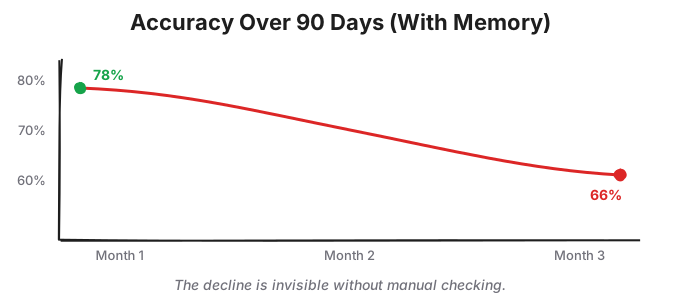
The chart tells the story. The agent wasn’t getting smarter. It was getting more confident about an increasingly stale version of reality.
The drift tax
I started calling this “The Drift Tax” — the hidden cost of letting an agent accumulate state. Every day an agent remembers, it moves slightly further from fresh observation and slightly closer to its own assumptions.
It’s like a doctor who stops examining patients because he’s seen “this type of case” a hundred times. The diagnosis comes faster. It’s also wrong more often.
But it sounds more confident, which is worse — because everyone trusts confidence.
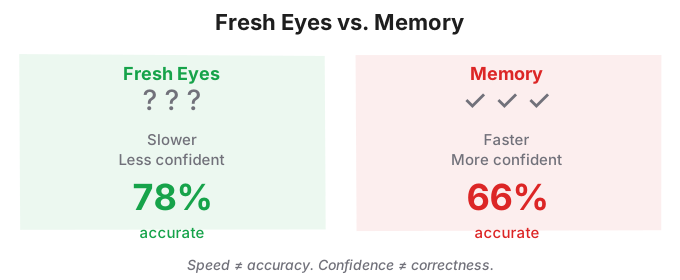
The experienced system looks better — faster, more decisive, more consistent. But consistent doesn’t mean correct. It means the system is reliably wrong in the same direction.
A diagnostic I run when something feels off:
Compare your system's output from day 1 to day 90.
Is it more accurate, or just more confident?
How would you know the difference?
This breaks the habit of treating consistency as proof of quality. Consistent output from a drifting system is the most dangerous kind — it never triggers your alarms.
The 24-hour rule
I wiped every agent’s memory. Fresh conversation, fresh context, every single run. The scoring agent reads product data with no memory of yesterday’s scores. The calendar agent reads the actual calendar, not its cached summary from last week.
My API costs went up about 20% — every run rebuilds context from scratch instead of continuing where it left off. The first week felt like regression. I sat there watching outputs come in on my phone, noticing the tone had changed — less polished, more hesitant, like a new employee double-checking things a veteran would breeze past.
But the accuracy jumped back to month-one levels overnight.
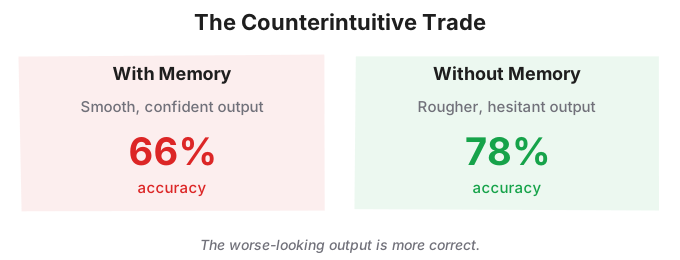
The less-confident output was more correct. I was paying 20% more for outputs that looked worse and were actually better. That trade took me a while to accept — the polished version felt right in a way the rougher version didn’t, even though the numbers told the opposite story.
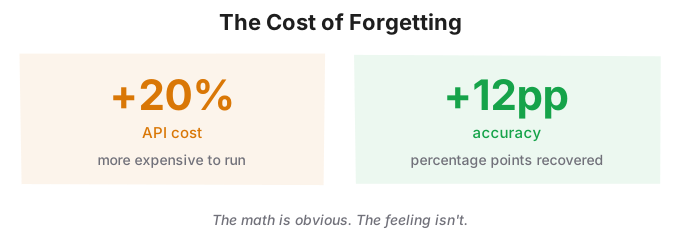
The numbers make it obvious. The feeling doesn’t.
Where this breaks
I should be honest: this doesn’t work for everything.
A chatbot that forgets your name every conversation is useless. A research agent that can’t build on previous findings is wasting your money. A personal assistant that doesn’t remember your preferences is just a search engine with a personality.
The rule is narrow: if an agent’s job is to observe reality — score something, summarize something, check something — don’t let it remember its opinions about reality. Feed it fresh data every time. Let it form fresh conclusions.
If an agent’s job is to build relationships or accumulate knowledge, memory is the whole point. The Drift Tax doesn’t apply there. The failure mode is different, and this approach would kill it.
The pattern nobody talks about
The Drift Tax shows up anywhere accumulated experience substitutes for fresh observation. Hiring managers who stop reading resumes carefully because “I know what a good candidate looks like.”
Analysts who update their forecasts instead of rebuilding them from raw data. Doctors who diagnose from the doorway because they’ve seen a thousand patients with the same symptoms.
In every case, the drift is invisible from the inside. The system feels more capable over time. The outputs come faster.
The confidence goes up. And somewhere underneath, the distance between what the system believes and what’s actually true grows by a fraction of a percent each day.
A question I ask about any system that accumulates state:
If you wiped this system's memory tomorrow,
what would it get RIGHT that it currently gets wrong?
What assumptions would disappear?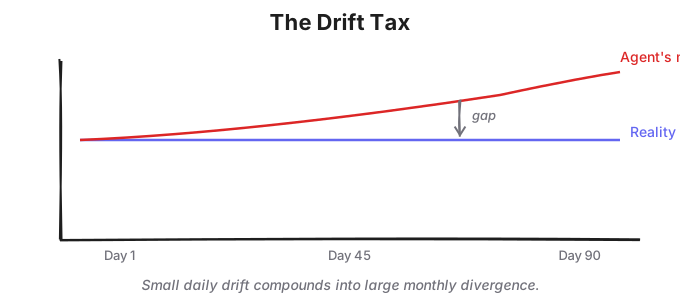
This shows the core of the Drift Tax — the gap between what’s real and what the system remembers is tiny each day but compounds like interest. By month three, the agent is living in a slightly different world than the one it’s supposed to be observing.
If an agent’s job is to observe reality, don’t let it remember its opinions about reality.
The agents that forget everything every morning are the ones I trust most. They’re slower, less confident, and 20% more expensive to run. They’re also the only ones I don’t have to spot-check at 1 AM.
I’ll take a goldfish with good eyes over an elephant with bad ones.
Building agents that run on autopilot? I’ve already made the memory mistakes — mo@fadaly.net.