APIErrorBudget — Per-Customer SLA Credit Tracker
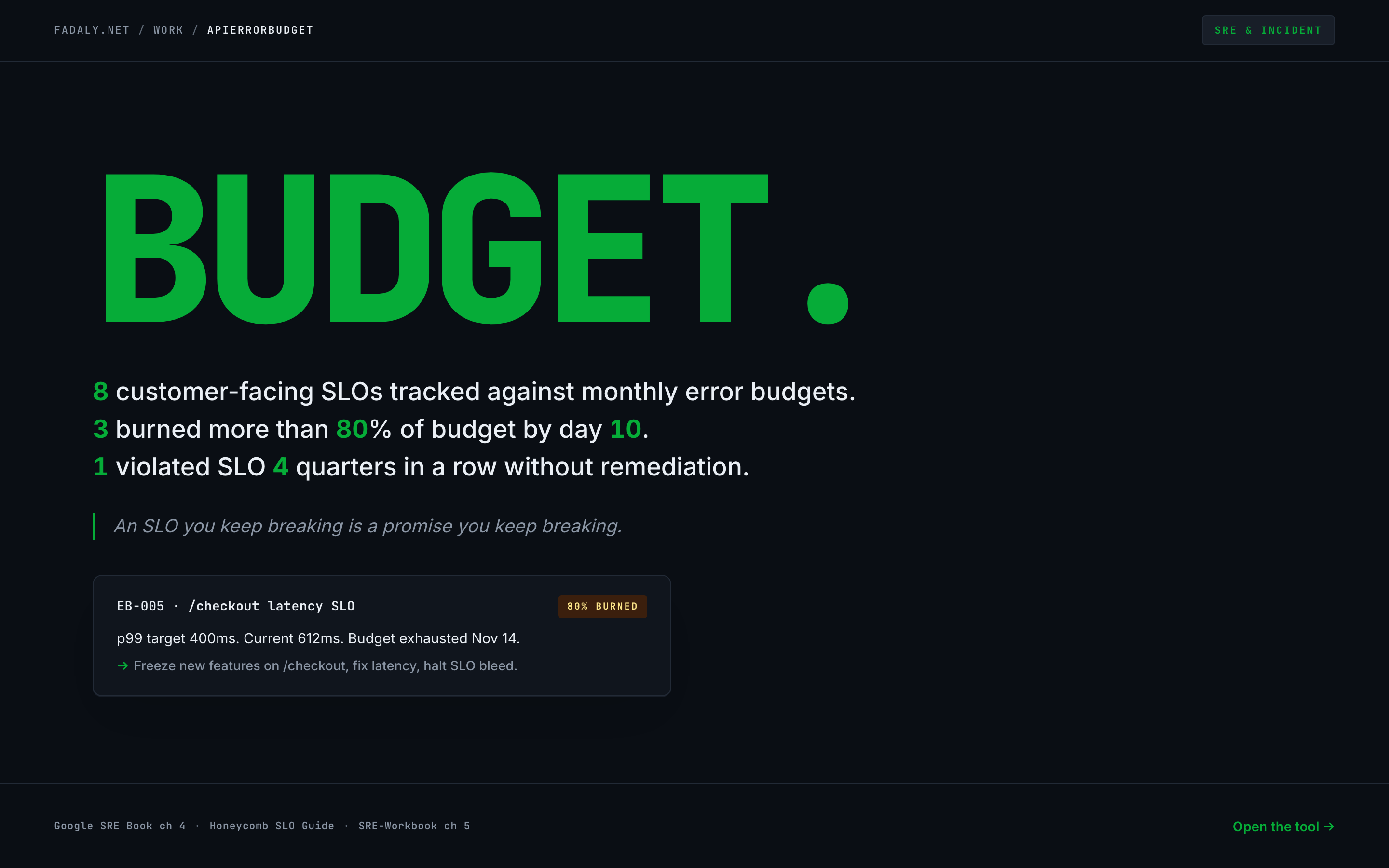
22 customer contracts × per-customer error-budget consumption. Per customer: tier, MSA SLA target, MRR, observed downtime min, 5xx rate, 429 rate, p99 exceedance, credit owed (% of MRR via standard ladder), notification status. Surfaces 4 customers eligible for SLA credit + 2 contracts with SLA mis-aligned with infrastructure reality.
What it is
The companion to SLOTracker (engineering-side error budget) — but pointed at the commercial reality: which customers are owed SLA credits based on their MSA tier, and have they been notified within the contractual window.
What’s in it
- 22 customer contracts spanning enterprise / growth / team tiers with realistic SLAs (99.99 / 99.95 / 99.9 / 99.5).
- Per-customer shape:
- Tier + SLA target + MRR
- 30-day observed uptime, downtime minutes
- 5xx rate, 429 rate, p99 exceedance %
- Credit owed (standard AWS-style ladder: 10% / 25% / 100% of MRR)
- Notification status (within 14-day MSA window?)
- Worst-offender findings:
- CST-003 Initech (enterprise, 99.95 target) — 180 min downtime → 10% credit ($2,800) owed → NOT NOTIFIED
- CST-005 Stark (enterprise 99.99) — 18 min vs 4.3-min budget → $6,800 credit, notified
- CST-008 Massive Dynamic (growth 99.9) — 88 min vs 43-min budget → $1,800 credit, NOT NOTIFIED
- CST-015 Oscorp (team 99.5) — 7-hour downtime vs 3.6-hour budget → $140 credit, NOT NOTIFIED
- 2 contract misalignments surfaced:
- CST-019 — promised 99.999% (5-min/year budget); infrastructure realistically delivers 99.95% (4h/year). Renegotiate at renewal.
- CST-020 — heavy 429 rate (8.4%); customer using free-tier limits at enterprise volume. Sales misalignment.
- Standard ladder visible — uptime ≥ SLA = no credit · ≥99.0% = 10% · ≥95.0% = 25% · <95.0% = 100% (AWS Service Credits model).
Why this shape
Google SRE Workbook ch. 4 distinguishes SLO (internal) from SLA (commercial) — APIErrorBudget is the SLA side. The hardest-to-track audit + customer-trust failure: not noticing a credit-owing breach until the customer asks. AWS / Stripe / Salesforce all enforce the 14-day notification window via MSA. APIErrorBudget prototypes the gate that surfaces credits proactively.
How it ships
Single HTML file, ~16KB. Zero dependencies. 22 customers × SLA ladder + per-customer error metrics in 200 lines of vanilla JavaScript.